

Hey there! I'm part of an automobile casting supplier, and today I wanna chat about how the casting process can mess with the microstructure of automobile castings.
First off, let's talk about what microstructure is. It's basically the tiny - scale structure of a material, like the arrangement of grains, phases, and any inclusions. In automobile castings, the microstructure can have a huge impact on the casting's properties, such as strength, ductility, and corrosion resistance.
There are different casting processes, and each one affects the microstructure in its own way. Let's start with sand casting, which is one of the oldest and most common methods. In sand casting, molten metal is poured into a sand mold. As the metal cools and solidifies, the cooling rate plays a crucial role in determining the microstructure.
If the cooling rate is slow, the grains in the casting will have more time to grow. This leads to a coarse - grained microstructure. Coarse - grained castings can be weaker and less ductile because the larger grains are more likely to have defects and can't resist deformation as well. On the other hand, if the cooling rate is fast, the grains don't have enough time to grow, resulting in a fine - grained microstructure. Fine - grained castings are generally stronger and more ductile, as the smaller grains can better distribute stress and resist crack propagation.
Another factor in sand casting is the type of sand used. Different sands have different thermal conductivities. For example, silica sand has a relatively low thermal conductivity. This means that when molten metal is poured into a silica sand mold, the cooling rate is slower compared to using a sand with higher thermal conductivity. So, choosing the right sand can help control the cooling rate and thus the microstructure of the casting.
Now, let's move on to die casting. Die casting is a process where molten metal is forced into a steel die under high pressure. One of the main advantages of die casting is that it can produce parts with high dimensional accuracy and smooth surfaces. But how does it affect the microstructure?
The high - pressure injection in die casting can lead to a more uniform distribution of the molten metal in the die cavity. This can result in a more homogeneous microstructure compared to sand casting. Also, the rapid cooling in die casting due to the high - thermal - conductivity steel die promotes the formation of a fine - grained microstructure. However, the high - pressure injection can also cause some issues. For instance, it can trap gas bubbles in the casting. These gas bubbles can act as stress concentrators and weaken the casting. To prevent this, proper venting systems need to be designed in the die.
In die casting, the alloy composition also plays a big role. Some alloys are more suitable for die casting than others. For example, aluminum alloys are commonly used in die casting for automobile parts. Different aluminum alloys have different microstructures and properties. Alloys with higher silicon content, for example, can have better fluidity during die casting, which can help fill the die cavity more completely. But silicon can also form hard particles in the microstructure, which can affect the machinability of the casting.
Investment casting is another process that's often used for complex - shaped automobile castings. In investment casting, a wax pattern is first made, then a ceramic shell is built around it. After the wax is melted out, molten metal is poured into the ceramic shell.
The ceramic shell in investment casting has a relatively high thermal insulation property. This can lead to a slower cooling rate compared to die casting. As a result, the microstructure of investment - cast parts may have larger grains compared to die - cast parts. However, investment casting can produce very accurate and detailed parts, which is important for some high - precision automobile components.
The choice of investment casting materials can also affect the microstructure. For example, the binder used in the ceramic shell can influence the reaction between the molten metal and the shell. Some binders can cause the formation of unwanted phases in the casting's microstructure, which can degrade the properties of the casting.
When it comes to specific automobile castings, let's take a look at some examples. Differential Housing Castings are an important part of the automobile's drivetrain. The microstructure of differential housing castings needs to be carefully controlled to ensure its strength and durability. A fine - grained microstructure can improve the casting's fatigue resistance, which is crucial as the differential housing is constantly subjected to cyclic loading.
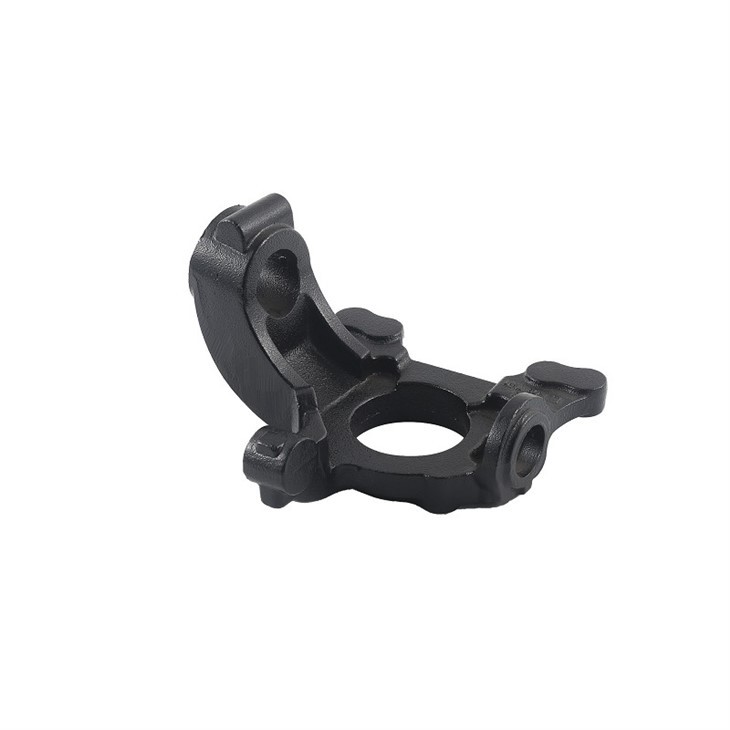
Steering Knuckle Castings are responsible for connecting the steering system to the wheels. The microstructure of steering knuckle castings affects their ability to withstand the complex forces during steering and braking. A homogeneous and fine - grained microstructure can enhance the casting's mechanical properties and reliability.
Beach Wheel Hub Castings need to be strong enough to support the weight of the vehicle and withstand the forces during driving. The casting process can impact the microstructure of wheel hub castings, which in turn affects their strength and safety. For example, controlling the cooling rate during casting can help prevent the formation of large pores or cracks in the microstructure, which could lead to premature failure of the wheel hub.

In conclusion, the casting process has a significant impact on the microstructure of automobile castings. Whether it's sand casting, die casting, or investment casting, each process has its own characteristics that can either promote or hinder the formation of a desirable microstructure. By understanding these relationships, we can optimize the casting process to produce high - quality automobile castings with the right microstructure and properties.
If you're in the market for high - quality automobile castings, we're here to help. We've got the expertise and experience to produce castings with the ideal microstructure for your specific needs. Whether it's Differential Housing Castings, Steering Knuckle Castings, or Beach Wheel Hub Castings, we can provide solutions tailored to your requirements. So, if you're interested in our products, don't hesitate to reach out and start a procurement discussion with us.
References
- Campbell, J. (2003). Castings. Butterworth - Heinemann.
-ASM Handbook Committee. (2008). ASM Handbook, Volume 15: Casting. ASM International. - Flemings, M. C. (1974). Solidification Processing. McGraw - Hill.