

Hey there! As a supplier of pumpworks castings, I've seen firsthand how heat treatment can make a world of difference in the quality and performance of our products. In this blog, I'm gonna break down how heat treatment improves pumpworks castings and why it's a game-changer for our customers.
Let's start with the basics. Pumpworks castings are used in a wide range of applications, from water pumps to industrial machinery. These castings need to be strong, durable, and resistant to wear and tear. That's where heat treatment comes in.
Heat treatment is a process that involves heating and cooling metal to alter its physical and mechanical properties. By carefully controlling the temperature and cooling rate, we can achieve specific characteristics in the casting, such as increased hardness, improved strength, and enhanced ductility.
One of the main benefits of heat treatment is that it can improve the hardness of the casting. Hardness is a measure of a material's resistance to indentation or scratching. In pumpworks castings, a higher hardness means better resistance to wear and abrasion, which is crucial in applications where the casting is in contact with fluids or solids.
For example, in a Casting Impeller, the blades need to be hard enough to withstand the high-velocity flow of fluid without getting worn down. By heat treating the impeller, we can increase its hardness and extend its service life.
Another important property that heat treatment can improve is strength. Strength refers to a material's ability to withstand external forces without breaking or deforming. In pumpworks castings, high strength is essential to ensure that the casting can handle the pressure and stress of the pumping system.
Heat treatment can also enhance the ductility of the casting. Ductility is the ability of a material to deform under tensile stress without fracturing. A more ductile casting is less likely to crack or break under stress, which is important in applications where the casting is subjected to dynamic loads or vibrations.
In addition to improving hardness, strength, and ductility, heat treatment can also reduce the internal stresses in the casting. During the casting process, internal stresses can build up due to uneven cooling or shrinkage. These stresses can cause the casting to warp, crack, or fail prematurely.
By heat treating the casting, we can relieve these internal stresses and make the casting more dimensionally stable. This means that the casting will maintain its shape and size over time, which is important for ensuring proper fit and function in the pumping system.

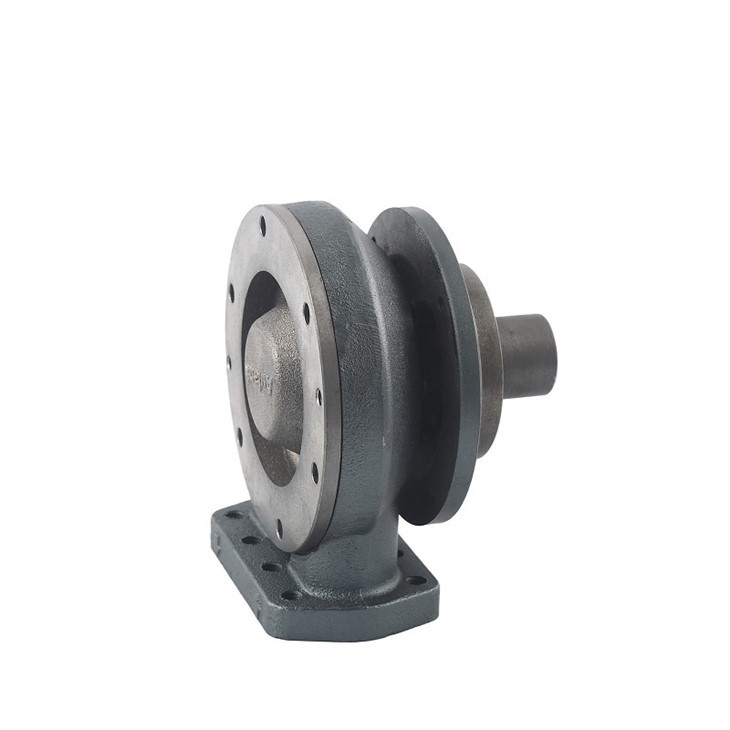
Now, let's talk about the different types of heat treatment that we use for pumpworks castings. There are several common heat treatment processes, including annealing, quenching, tempering, and normalizing.
Annealing is a heat treatment process that involves heating the casting to a specific temperature and then slowly cooling it. This process is used to soften the casting, reduce internal stresses, and improve its machinability. Annealing is often used before machining to make the casting easier to work with.
Quenching is a rapid cooling process that involves immersing the heated casting in a liquid, such as water or oil. Quenching is used to harden the casting by forming a martensitic structure. Martensite is a very hard and brittle phase of steel that is formed when the steel is cooled rapidly from a high temperature.
Tempering is a heat treatment process that is used after quenching to reduce the brittleness of the martensitic structure and improve its toughness. Tempering involves heating the quenched casting to a lower temperature and then holding it at that temperature for a specific period of time.
Normalizing is a heat treatment process that is similar to annealing, but it involves cooling the casting in air instead of slowly in a furnace. Normalizing is used to refine the grain structure of the casting and improve its mechanical properties.
The choice of heat treatment process depends on the specific requirements of the casting and the material used. For example, if the casting needs to be very hard and wear-resistant, quenching and tempering may be the best option. If the casting needs to be more ductile and less brittle, annealing or normalizing may be more appropriate.
As a pumpworks castings supplier, we have the expertise and equipment to perform a variety of heat treatment processes. We work closely with our customers to understand their specific needs and recommend the best heat treatment solution for their application.
In addition to improving the quality and performance of our castings, heat treatment also offers other benefits. For example, heat-treated castings are often more consistent in terms of their properties, which means that our customers can expect better performance and reliability from our products.
Heat treatment can also reduce the cost of production in the long run. By improving the durability and service life of the castings, we can reduce the need for frequent replacements and repairs, which can save our customers money in the long term.
So, if you're in the market for high-quality pumpworks castings, I encourage you to consider heat treatment. At our company, we're committed to providing our customers with the best possible products and services. We use the latest technology and techniques to ensure that our castings meet the highest standards of quality and performance.
If you have any questions or would like to learn more about how heat treatment can improve your pumpworks castings, please don't hesitate to [contact us](insert real contact method). We'd be happy to discuss your specific needs and provide you with a quote.
In conclusion, heat treatment is a powerful tool that can significantly improve the quality and performance of pumpworks castings. By carefully controlling the heat treatment process, we can achieve specific properties in the casting, such as increased hardness, improved strength, and enhanced ductility. Whether you're looking for a Casting Impeller, Submersible Pump Casting Parts, or Pump Cover Castings, heat treatment can help you get the most out of your investment.
References
- Metals Handbook: Heat Treating, ASM International
- Heat Treatment Principles and Techniques, by R. A. Grange, C. R. Hribal, and L. F. Porter
- The Science and Engineering of Materials, by Donald R. Askeland and Pradeep P. Phule